What Is Lead Attribution? A Guide for Contractors


In This Article
- Why lead attribution matters for contractor growth
- The key difference between lead tracking and attribution
- First-touch, last-touch, and multi-touch attribution models
- Deconstructing the contractor customer journey
- Attributing phone leads and website forms
- Revenue attribution and tracking ROI inside the CRM
A roofing company might be running Google Ads, local SEO, Google Business Profile optimization, Meta ads, email campaigns, and referral networks. A homeowner may interact with several of these touchpoints before ever picking up the phone to request an estimate. When the phone finally rings, the question becomes: Who gets credit for the lead? That is what lead attribution is designed to answer.
Attribution helps contractor businesses understand which marketing sources and digital touchpoints contributed to calls, forms, appointments, opportunities, closed jobs, and revenue. Tracking tells you that a lead happened. Attribution helps explain why it happened.
What Is Lead Attribution?
Lead attribution is the process of connecting a lead or customer back to the marketing sources and touchpoints that influenced the conversion. For example, a simple path might look like Google Search → Website → Phone Call. A more complex path could involve an Instagram Ad → Website → Google Search → Website → Estimate Request. Attribution determines how credit is assigned across these interactions to guide smarter marketing investments.
Lead Tracking And Lead Attribution Are Not The Same Thing
While the two terms are often used interchangeably, they serve different functions. Lead tracking records that a conversion event occurred (e.g., a phone call or form submission). Lead attribution determines the specific marketing source, campaign, or user touchpoint that helped cause that conversion.
In short, tracking records the conversion. Attribution explains the journey behind it. If you want to learn more about the technical setup of tracking, review our guide on how to track every lead from your website. This article will focus instead on how to make sense of the credit.
Why Lead Attribution Matters For Contractors
Contractors invest substantial money across multiple channels—Google Search, Google Ads, Google Business Profile, Meta, direct mail, and referrals. Without attribution, you have no clear way to verify which channels actually generate qualified jobs. Decisions are made based on impressions, clicks, website traffic, or gut feeling rather than qualified opportunities, proposal estimates, closed jobs, and bankable revenue. The goal is not to know which channel gets the most clicks. The goal is to know which channels help create profitable customers.
A Contractor Lead Rarely Comes From One Click
Most home improvement projects involve a high average ticket and a longer consideration period. Homeowners do not hire a roofer or window contractor on a whim. Consider this typical customer journey:
Day 1: A homeowner sees a Meta ad showing a window installation project. Day 3: They search for the company name on Google to read reviews. Day 5: They visit the website directly. Day 7: They check local references or review location pages. Day 10: They check financing options. Day 12: They call the office to schedule an estimate. Which interaction created the lead? Depending on which attribution model you use, the answer will change.
First-Touch Attribution
In the first-touch attribution model, the first interaction receives 100% of the credit. In our window replacement example, Meta receives the credit because it introduced the homeowner to the brand. This model is highly useful when you want to measure top-of-funnel discovery and awareness. Its main weakness is that it ignores all subsequent touchpoints that educated, nurtured, and ultimately converted the visitor.
Last-Touch Attribution
Under the last-touch attribution model, the final interaction before the conversion receives 100% of the credit. If the homeowner's last action was searching on Google and calling from the organic listing, organic search gets the credit. Last touch is the default model in most basic tracking setups. It is useful for understanding the immediate triggers that close journeys. However, it severely undervalues earlier marketing activity. Last touch tells you who was holding the ball when the customer crossed the goal line. It does not necessarily tell you who moved the ball down the field.
Multi-Touch Attribution
Rather than assigning all the credit to the first or last interaction, multi-touch attribution distributes credit across several touchpoints in the customer journey. For instance, the credit might be split between the Meta ad (which generated awareness), the Google Search (which facilitated research), and the final direct visit (which initiated the call). While multi-touch models provide a more complete view of the marketing mix, they are more complex to implement and analyze. The contractor needs to understand the concept and business implications rather than getting bogged down in analytics calculations.
Which Attribution Model Should Contractors Use?
No single attribution model is universally correct. The right model depends on the specific questions you are trying to answer. Use first-touch when asking: What creates initial awareness and discovery? Use last-touch when asking: What most often creates the final conversion action? Use multi-touch when asking: What combinations of marketing activity contribute to the sale?
Remember: No attribution model perfectly recreates human decision-making. The goal is better information to guide your growth decisions, not fake certainty.
Lead Source Is Not The Same As Lead Attribution
Most CRMs contain a simple field labeled 'Lead Source' (e.g., 'Google' or 'Facebook'). This is useful but limited. Attribution preserves deeper context, including the specific search terms, ad groups, landing pages, and middle-funnel touchpoints. 'Google' is a lead source. 'Organic search → roofing page → return visit → phone call → sold roof' is an attribution story.
The Channels Contractors Should Be Able To Attribute
To optimize your marketing, you should be able to attribute leads to the following primary channels:
- Google Ads: Track call extensions, landing page form submissions, and Google Ads conversion tracking.
- Organic Search: Track organic SEO clicks, location pages, and service page inquiries.
- Google Business Profile: Track Google Maps local calls, directions clicks, and appointment links.
- Meta Ads: Attribute leads driven by Facebook or Instagram campaigns, including multi-visit journeys.
- Referrals & Offline: Track builder networks, direct mail QR codes, and word-of-mouth recommendations.
Why Phone Calls Make Contractor Attribution Harder
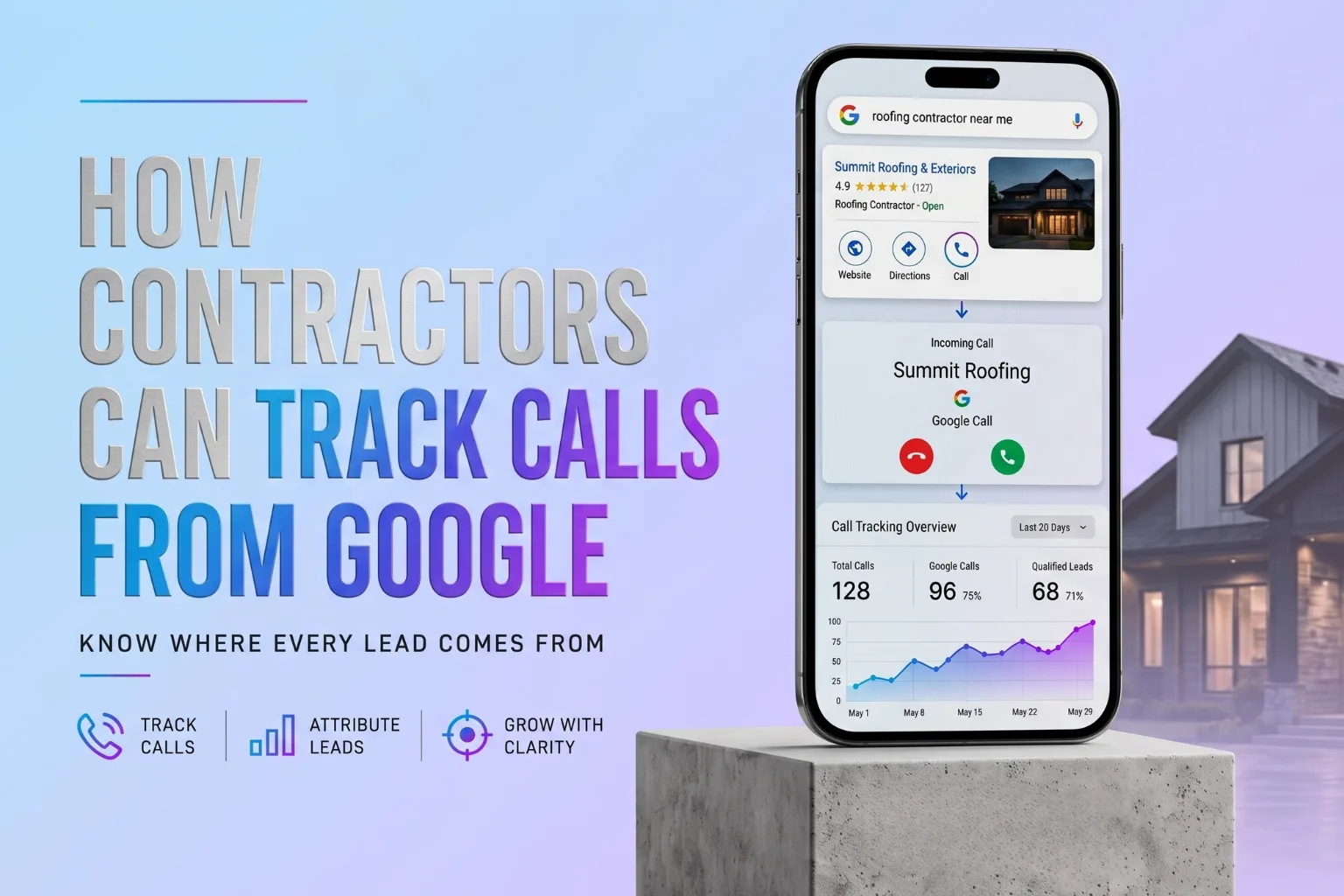
Many high-value contractor leads choose to call rather than fill out forms. When a homeowner searches for emergency services, they want an immediate answer. If they search on a phone, visit your site, and tap the phone number, standard web analytics may lose the trail. Connecting calls to marketing sources requires call tracking and dynamic number insertion (DNI) integrated directly with your CRM. For details on how to set this up, refer to our guide on how to track every lead from your website.
Forms Can Lose Attribution Too
Form submissions can also lose attribution if campaign UTM parameters disappear between pageviews, or if your form fails to pass this data into your CRM. When this happens, the lead record displays 'Website' as the source. 'Website' should rarely be the end of the attribution conversation. The website is usually the destination, not the source. You must preserve the campaign cookies to know what generated the website visit.
What Happens When A Lead Becomes A Sale?
Attribution becomes much more valuable when it moves beyond lead generation into closed contracts. For example, consider this hypothetical scenario:
Google Ads generates 20 leads, resulting in 2 closed jobs. Local SEO generates 12 leads, resulting in 6 closed jobs. If you only look at lead volume, Google Ads appears more successful. In reality, SEO drove three times as many closed jobs and a higher overall return on investment. Lead attribution becomes far more useful when it survives long enough to reach the bank account.
Revenue Attribution Is Where Marketing Gets Interesting
True revenue attribution tracks the journey from Traffic → Lead → Qualified Opportunity → Proposal → Closed Job → Revenue. This level of tracking allows you to answer critical business questions:
- Which marketing channels generate the most revenue?
- Which sources generate larger, high-margin projects?
- Which campaigns generate low-quality, unprofitable inquiries?
- Which cities or zip codes have the highest sales close rates?
Connecting these dots requires complete tracking infrastructure. To learn how we build these systems, see our conversion and sales tracking service page.
Attribution Can Prevent You From Cutting Marketing That Is Actually Working
Without proper attribution, you risk cutting marketing channels that play a critical supporting role. For example, a contractor might turn off a Meta branding campaign because it generates very few direct 'last-click' leads. However, attribution data might show that many customers first discovered the brand via Meta, then searched on Google later to schedule an estimate. Turning off Meta would cause organic search leads to decline. Bad attribution can make good marketing look bad, and conversely, it can make weak marketing look better than it is.
Attribution Does Not Mean Pretending Every Customer Journey Is Perfectly Measurable
Attribution is not a surveillance system; it is a decision-making tool. Cookie restrictions, browser privacy updates, multiple family devices, offline referrals, word-of-mouth, and spouses researching separately mean you will never have 100% visibility into human behavior. The objective is to gain sufficient data to make confident marketing decisions, not to claim perfect visibility.
The Data A Contractor Should Preserve
To build a reliable attribution dashboard, ensure your CRM captures and associates the following data fields with each lead record: original source, medium, campaign name, UTM tags, first landing page, conversion type, lead status, estimated job value, and closed invoice revenue.
Lead Attribution Inside The Zeus Five Levels
At Zeus Media, we organize contractor marketing around the Five Levels: Visibility, Trust, Conversion, Tracking, and Scaling. You cannot intelligently scale what you cannot reliably attribute. Once you get found (Visibility), build credibility (Trust), and generate inquiries (Conversion), lead attribution (Tracking) reveals what is working so you can confidently deploy capital to grow (Scaling).
What Does A Good Contractor Attribution System Actually Answer?
A completed tracking system should tell you: Where did this lead first discover us? What brought them back? Which page converted them? Did they call or submit a form? Which service were they interested in? Did the sales team qualify the lead? Did the estimate close? How much revenue did the job create? If your tracking can consistently answer these questions, you are operating with far more useful information than simple website traffic reports provide.
Frequently Asked Questions
Frequently Asked Questions
What is lead attribution?
What is the difference between lead tracking and lead attribution?
What is first-touch attribution?
What is last-touch attribution?
What is multi-touch attribution?
How can contractors track where phone leads come from?
Can lead attribution show which marketing channels generate revenue?
Joshua Johnson specializes in contractor marketing across South Florida, helping roofing, HVAC, and remodeling companies rank higher and generate more leads through local SEO and conversion-focused websites.
Related Resources