The Complete Contractor SEO Guide for South Florida


In This Article
- Optimize Your Google Business Profile (GBP)
- Develop a Review Generation System
- Create Dedicated Service and Location Pages
- Prioritize Website Mobile Experience
- Build Local Authority with Citations and Backlinks
- Develop Helpful Content
- Track Every Lead
Contractor SEO in Florida is not simply about ranking a homepage for one broad keyword. A roofing company in Miami, an impact-window company in Broward County, and an HVAC contractor in Palm Beach County may all compete differently because search demand changes by city, competition varies by market, proximity affects local results, services have different commercial value, hurricane and weather-related demand can influence search behavior, affluent markets may create different customer economics, and Google Business Profile competition varies dramatically. A contractor SEO strategy should reflect the actual markets, services, and customers the business is trying to win.
Earning search engine visibility requires a complete understanding of how local property owners evaluate and select service crews. This guide outlines the complete organic growth strategy for South Florida construction, building, and repair businesses.
What Is Contractor SEO?
Contractor SEO is the comprehensive process of improving a home service company's organic visibility across search results. A complete strategy includes service keyword visibility, local search optimizations, Google Maps prominence, localized location pages, trade-specific industry content, technical website usability, user reviews, clean internal linking, conversion optimization, and pipeline tracking. Earning traction with SEO for contractors in Florida requires coordinating each of these disciplines into one connected growth system. For a broader view of this topical cluster, review our contractor local SEO resources.
Why Contractor SEO in Florida is More Competitive than Generic SEO
South Florida—spanning Miami-Dade, Broward, and Palm Beach counties—constitutes one of the most competitive contracting environments in the country. Because of high property values, year-round construction activity, and weather-driven demand (like hurricane protection and HVAC requirements), the search market is highly saturated.
Local contractors compete against national service networks, heavily capitalized regional brands, established listing directories, and companies with massive historical review profiles. A contractor does not compete against “Google.” They compete against the businesses Google already has strong reasons to trust. Breaking through requires a professional strategy rather than generic keywords.
Contractor SEO in Miami Requires More than Adding Miami to a Page
Miami is not one homogenous search market. A property owner in Coral Gables searches differently and has different service expectations than a homeowner in Hialeah, Kendall, Miami Lakes, or Aventura. Earning rankings for contractor SEO Miami requires targeting the specific sub-markets your team actually services.
Do not mass-produce thin, low-quality neighborhood pages with copy-pasted copy; search engines quickly filter out duplicate text. Instead, build location landing pages that highlight real local projects, local permits, community testimonials, and relevant regional service priorities. The goal is not to mention Miami more often. The goal is to give Google more useful evidence that the business is relevant across the markets it actually serves.
South Florida Contractor SEO Should Follow the Customer Journey
Home service searches are highly intent-driven. Homeowners generally follow a predictable decision-making path when selecting a contractor:
- Problem Identification: A homeowner notices a leak, AC failure, or drafty window.
- Google Search: They look up solutions or local professionals (e.g., 'roof repair Broward').
- Google Maps Inspection: They review the Local 3-Pack list to find nearby businesses.
- Trust Evaluation: They read customer reviews and examine project photos.
- Website Research: They click through to confirm service expertise and financing choices.
- Conversion Action: They tap the click-to-call button or submit a quote request form.
SEO strategy cannot stop once a user clicks onto your page. Your site must load fast, look professional, and make contacting your office effortless. Ranking creates the opportunity. The rest of the website still has to earn the lead.
Service Pages Tell Google What Your Business Should Rank For
One of the most common contractor SEO mistakes is listing all services on a single, generic page. Search crawlers struggle to index websites that group roof repair, commercial coating, siding installation, and leak detection into one paragraph. Your site needs a dedicated service page for each core service you offer. Consider how search intents differ across key contracting trades:
- Roofing: Dedicate distinct pages to roof repair, roof replacement, metal roofing, tile roofing, and commercial coatings.
- Impact Windows: Group content around impact windows, impact entry doors, sliding glass doors, and commercial glazing.
- HVAC: Separate AC repair, emergency system replacement, duct cleaning, and preventative maintenance.
- Pest Control: Focus on termite treatments, rodent control, emergency pest control, and recurring home protection packages.
- Plumbing: Target emergency drain cleaning, water heater repair, leak detection, and plumbing pipe inspections.
The homepage explains the business. Service pages explain the expertise. Building dedicated pages allows you to target long-tail keywords with higher conversion rates.
Location Pages Should Build Real Geographic Relevance
Location pages expand your geographic footprint. A roofing contractor based in Fort Lauderdale needs location pages targeting Hollywood, Davie, and Weston to capture searches in those municipal zones. However, location pages must offer real value to human visitors.
A helpful location page should outline local building permit resources, highlight recent projects completed in that city, embed local customer reviews, and coordinate maps directions. A location page should help the visitor continue the buying journey, not simply prove that a city name exists on the website. For visual structuring guidance, refer back to the main local SEO resources hub.
Miami-Dade, Broward, and Palm Beach are Distinct Search Markets
Contractors operating across South Florida must recognize that search competition varies county by county. Ranking in Palm Beach County is a different challenge than ranking in Miami-Dade. Factors influencing local difficulty include regional contractor density, median home age (which dictates repair vs. replacement demand), local wind-load zoning (which drives impact window requirements), and competitor review volume.
Your local SEO strategy should evaluate where your business has physical proximity, where your past project portfolios are densest, and which services carry the highest profit margin in each county. South Florida is one region operationally, but search competition happens market by market.
Google Maps Is Often the First SEO Battleground
For local contractors, appearing in the Google Maps Local 3-Pack is critical. Proximity to the searcher remains a dominant signal, but contractors can improve their rankings through active profile management. Choose the correct primary category (e.g., 'Roofing Contractor' or 'HVAC Contractor'), list all your service subcategories, upload geotagged project photos regularly, and reply to all customer reviews.
To build a strong maps foundation, align your profile settings with our checklist for Google Business Profile Optimization.
Reviews Are a Competitive Asset, Not Just Social Proof
Reviews play a central role in both local search algorithms and consumer trust. When a homeowner is preparing to spend $20,000 on a roof replacement or $30,000 on impact windows, they will research review profiles thoroughly before requesting an estimate. Steady review velocity (receiving new reviews consistently) and review diversity (getting reviews mentioning specific services and cities) prove to Google that your business is active and reliable.
Contractor SEO Strategy Should Prioritize Business Value, Not Just Search Volume
Generic agency SEO packages focus on vanity metrics like total keyword volume or raw traffic. A modern contractor SEO strategy prioritizes business metrics like lead quality, close rates, and average job value. For example, a keyword like 'commercial roof restoration Fort Lauderdale' may only have 20 searches a month, but winning one contract is worth more than ranking for hundreds of informational terms. The best SEO keyword is not always the one with the most searches. It is the one that creates the right business opportunity.
Internal Linking Turns SEO into a System
Search engine crawlers understand website hierarchy through internal link structures. Your service pages, location pages, industry guides, and case studies should link back and forth contextually to build topical authority. A service page on impact windows should link directly to your Miami location page and a related impact window case study. This tells search engines that your business has verified experience in that service within that specific market. The goal is not to publish isolated pages. It is to build a connected body of evidence.
Answer the Questions Customers Ask Before They Call
Homeowners perform extensive research before contacting a contractor. Your website should address their questions directly through helpful articles and FAQs:
- Pricing Guides: How much does a roof replacement cost in South Florida? What affects impact window prices?
- Comparisons: Hurricane shutters vs. impact windows. Repairing vs. replacing an aging AC unit.
- Process Guides: What permits are required for a kitchen remodel in Broward County? How long does window installation take?
- Material Guides: Tile vs. metal roofing for coastal wind exposure. Choosing the right energy-efficient glass.
Technical SEO Still Matters
Technical optimization ensures search engines can crawl, index, and render your website without errors. Maintain a clean XML sitemap, deploy schema markup (like LocalBusiness and Product schemas), optimize image sizes to improve mobile page speed, fix broken links, and verify SSL security. A fast, secure website builds trust with both search engines and users.
Tracking Organic Leads Is Part of the SEO Strategy
Organic traffic metrics are meaningless if they do not convert into won jobs and bankable revenue. You must be able to trace which organic landing pages, keywords, or Google Maps listings drive actual phone calls, estimate requests, and booked appointments. Ranking is an SEO metric. Revenue is a business metric. A serious strategy should eventually connect the two.
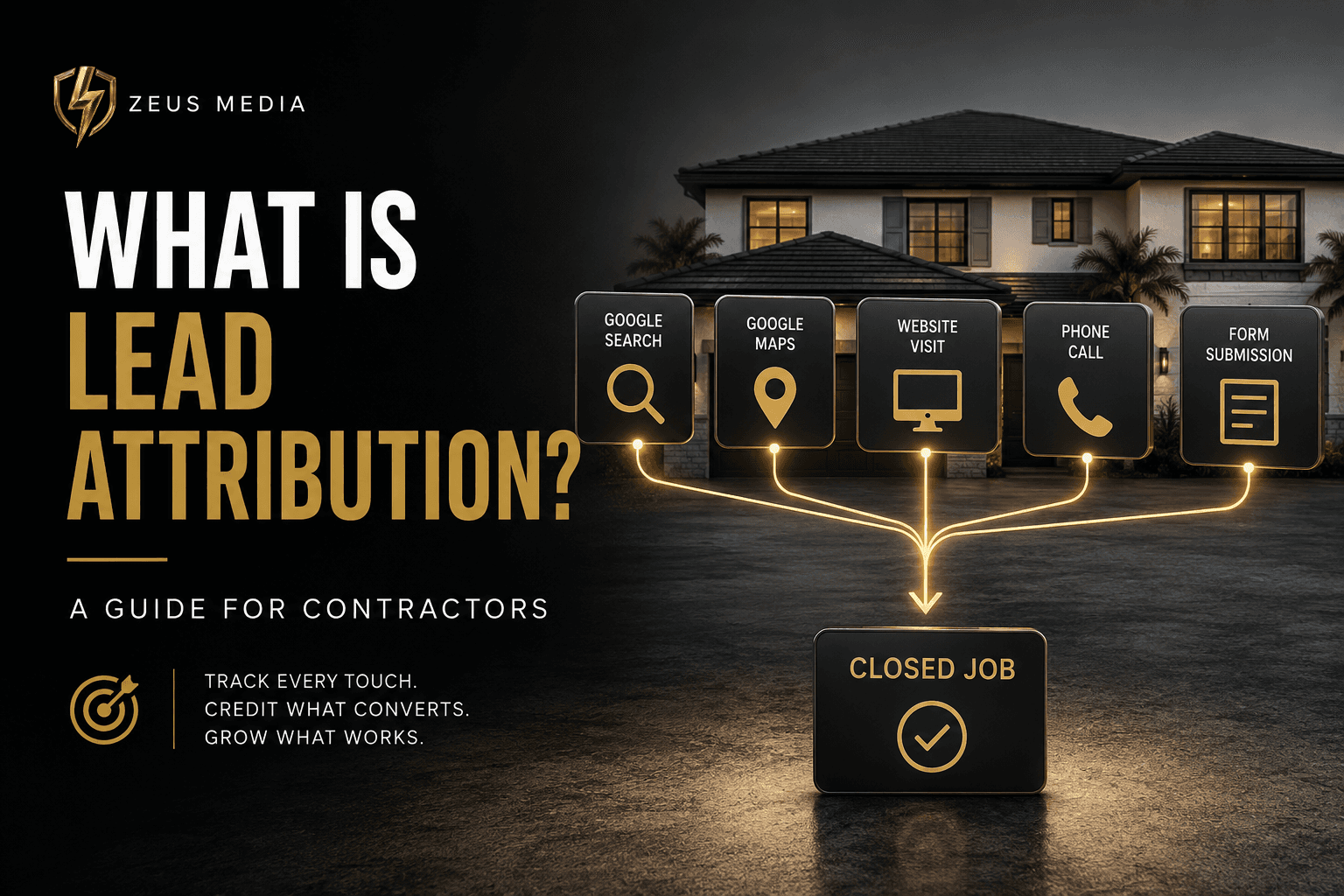
To build a complete tracking system, capture campaign UTM cookies on your forms and integrate them with your CRM. For instructions, read our guides on how to track every lead from your website and what is lead attribution, or explore our Conversion & Sales Tracking services page.
A Practical South Florida Contractor SEO Strategy
Contractor SEO System Diagram:
Technical Foundation → Service Architecture → Location Relevance → GBP & Reviews → Content & Authority → Leads & Revenue
To execute this system, contractors should follow this structured sequence:
- 1. Audit and fix technical indexing, sitemaps, and mobile speed issues.
- 2. Build dedicated service pages for each core offering.
- 3. Optimize Google Business Profile categories, services, and geographic details.
- 4. Build high-quality location landing pages for target markets.
- 5. Implement an automated review request workflow for completed projects.
- 6. Publish educational content addressing pricing, permit, and comparison questions.
- 7. Connect service, location, and industry pages using contextual internal links.
- 8. Deploy call tracking and CRM lead source tracking to measure results.
What Should a Contractor Prioritize First?
Not every business starts from the same position. Use this diagnostic priority tree to align your efforts:
- If rankings are weak everywhere: Focus first on technical foundations, core service pages, and primary GBP settings.
- If Google Maps visibility is weak: Prioritize review generation, GBP category details, and uploading local photos.
- If one city ranks but surrounding areas do not: Review location page architecture and expand local link outreach.
- If traffic is growing but leads are flat: Audit your mobile call-to-action layout and form complexity.
- If leads are high but marketing ROI is unclear: Implement call tracking, dynamic number insertion (DNI), and CRM revenue integration.
Frequently Asked Questions
Frequently Asked Questions
What is SEO for contractors?
How does contractor SEO work in Florida?
How can a contractor rank higher in Miami?
What is the difference between contractor SEO and local SEO?
Do contractors need location pages?
How important is Google Business Profile for contractor SEO?
How long does contractor SEO take?
How do contractors track leads from SEO?
Joshua Johnson specializes in contractor marketing across South Florida, helping roofing, HVAC, and remodeling companies rank higher and generate more leads through local SEO and conversion-focused websites.
Related Resources