Why Most Contractor Websites Don't Generate Leads (And How to Fix Them)


In This Article
- Why home service companies have a website conversion problem, not a lead problem
- The 16 structural and design bottlenecks killing your online credibility
- Core ingredients of a premium, high-converting digital storefront
- How strategy changes between roofing, HVAC, impact windows, and outdoor living
- Crucial local SEO and trust priorities for South Florida contracting businesses
Every single day, thousands of home service business owners across the country log into their advertising dashboards, look at their monthly marketing expenses, and ask the exact same question: 'Why isn't our website booking more jobs?' They see the traffic numbers rising, they see their budget disappearing, but the phone remains quiet. The default response is to assume they have a traffic or lead generation problem. They hire a new SEO company, pump more money into Google Local Services Ads, or run social media campaigns. Yet, the results remain frustratingly identical.
The truth is, most home service businesses do not have a lead problem. They have a contractor website conversion problem. When your digital storefront is built like a static digital brochure rather than a high-performance sales asset, every dollar you spend on advertising, contractor marketing, or search visibility is severely diluted. Traffic is only valuable if your website has the psychological trust triggers, clear value propositions, and technical speed required to turn an anonymous click into a high-intent scheduled estimate. If your website fails to build immediate credibility, your visitors will simply bounce back to search and click on your competitor's listing.
In this comprehensive guide, we will break down the exact reasons why most contractor websites fail to generate jobs, the crucial mechanics of website conversion optimization, and a practical blueprint to transform your online presence into a lead-generating machine. Whether you are a roofing contractor in Fort Lauderdale, an HVAC company in Miami, an impact window installer in Boca Raton, or a luxury pool builder in West Palm Beach, this guide will show you how to audit your site, fix hidden leaks, and engineer a digital platform built for scale.
Your Website Is No Longer A Digital Brochure
Ten years ago, a contractor website could succeed simply by listing your phone number, showing a logo, and hosting a basic contact form. Homeowners had fewer options and lower expectations. Today, consumer psychology has shifted dramatically. Homeowners are bombarded with advertisements and options. When they need a major home improvement project—like a twenty-thousand-dollar roof replacement, a luxury outdoor living area, or a complete HVAC changeout—they perform intensive research. They evaluate your brand identity, look for signs of authority, read reviews, inspect your past work, and judge your credibility based on the speed and design of your website.
A premium home service website design must function as a digital showroom. It needs to reflect the high quality of your craftsmanship. If you claim to build high-end luxury backyards or install premium impact windows but your website looks outdated, pixelated, or slow, you create immediate cognitive dissonance in the mind of the user. Your website layout and contractor branding must align perfectly with the pricing and professionalism you deliver in the field. To scale a modern home services brand, you must treat your website design as the absolute center of your sales process—a machine engineered to establish trust, answer buyer objections, and drive action.
The Biggest Reasons Contractor Websites Fail
To build a site that consistently generates inbound inquiries, we must first diagnose the structural, visual, and copy flaws that actively kill conversions. Here are the sixteen most common reasons home service websites fail to perform.
1. No Clear Value Proposition
When a homeowner lands on your site, they need to know exactly what you do, who you serve, and why you are the best choice in less than three seconds. Most contractor websites fail this test by using generic messaging like 'Quality Service Since 1998' or 'Your Trusted Local Contractor'. This does not tell the prospect why they should choose you over five other tabs they have open. To fix this, state your primary service, target location, and unique advantage immediately. For example: 'Premium Impact Windows & Doors Installed by Certified South Florida Craftsmen' sets a clear value proposition and immediately filters out low-intent searchers.
2. Weak Headlines
Your headline is the first thing a user reads. If it is dry, technical, or self-centered, it will fail to hold attention. Headlines like 'Welcome to Apex Construction' or 'We Do Roofing and Remodeling' focus on you rather than the customer's desires or pain points. Instead, write headlines that address the user's ultimate goal: 'Get a Leak-Free Roof in 7 Days with Boca Raton's Top Roofing Team' or 'Upgrade to Impact Windows with $0 Down and Hurricane Protection'. Focus on speed, safety, trust, and clear outcomes to keep visitors reading.
3. Generic Stock Photography
Nothing kills credibility faster than generic, smiling models holding tools they have never used or clip-art houses that look nothing like South Florida architecture. Homeowners can spot stock photos instantly. When you use stock photography, you send a subconscious signal that you have no real projects to show, or worse, that your real projects are not worth photographing. Replace all stock imagery with real, high-resolution photography of your actual crew, wrapped trucks, and completed jobs. Showing your real team in action builds immediate human connection and validates your local footprint.
4. Poor Contractor Branding
Many home service companies suffer from outdated, crowded, or unprofessional logos and brand styling. If your logo has five different colors, a complex mascot, and a generic clip-art hammer, it will look cheap and amateurish. Premium contractor branding uses clean typography, structured grids, a modern color palette, and high-end styling. A luxury home design brand should feel premium, sleek, and minimalist. If your visual branding is weak, you will struggle to command high prices and attract luxury residential clients.
5. Slow Load Times
In modern digital marketing, speed is a critical ranking and conversion factor. If your website takes more than three seconds to load, over half of your visitors will bounce. Heavy, unoptimized project images, uncompressed background videos, and poor hosting servers are the primary culprits. Home service websites must utilize modern image compression (like WebP format), lazy loading techniques, and fast content delivery networks (CDNs). A lightning-fast site improves user experience and signals to Google's ranking algorithm that your website is high quality.
6. Weak Mobile Experience
Over 80% of local home service searches occur on mobile devices. If a homeowner has a leaking roof or a broken AC, they are searching from their phone. If your website's mobile layout is difficult to navigate, has small text, overlapping blocks, or tiny buttons that are hard to tap, visitors will leave immediately. Ensure your mobile design has a sticky 'Call Now' button at the bottom, simplified contact forms with touch-optimized fields, and a fast-loading layout designed specifically for vertical screens.
7. No Local SEO Structure
To generate organic leads, search engines need to understand exactly which cities and services you cover. A single generic contact page is not enough. You need built-out location-specific landing pages and dedicated service pages. For example, a South Florida roofing website design should have target pages for Miami local SEO, Fort Lauderdale contractor SEO, Boca Raton contractor website design, and West Palm Beach contractor marketing. A structured service-area architecture allows you to target high-intent local queries and rank in Google's Local Map Pack.
8. Poor Navigation
If a user has to search through a confusing drop-down menu to find your pricing, reviews, or project gallery, they will get frustrated and leave. Keep your primary menu minimal and intuitive. Focus on the core links your prospects care about: Services, Projects, Pricing, About Us, and a highly visible call to action. Organize your services by clear categories so users can find exactly what they need in a single click.
9. Weak Calls To Action
Generic, low-contrast buttons like 'Submit' or 'Learn More' do not encourage actions. Your Call to Action (CTA) must stand out visually and state the exact next step. Use a bright, contrasting accent color (like Zeus Gold) and action-focused copy: 'Request My Free Inspection', 'Get an Instant Estimate', or 'Schedule My AC Diagnostic'. Place your primary CTA in the top right corner of the header, in the middle of the hero section, and repeatedly throughout the page content.
10. Missing Reviews
Homeowners rarely hire a contractor without checking reviews first. If you do not display testimonials directly on your website, you force visitors to leave your site and search for reviews on Google, Yelp, or Facebook—where they might get distracted by competitor ads. Integrate authentic customer reviews directly onto your homepage and service pages. Include the customer's name, city, and a link to verify the review source to establish absolute trust.
11. No Before & After Projects
Homeowners want proof of your craftsmanship. They want to see what your work looks like in real homes, particularly in their local neighborhood. A weak or missing portfolio gallery is a major conversion killer. Showcase detailed project case studies featuring before-and-after sliders, high-resolution photography, project descriptions, list of materials used, and city locations. This proves your capabilities and creates local relevance.
12. No Financing Information
Home improvement projects represent a significant financial investment. For many homeowners, financing is the deciding factor in choosing a contractor. If you offer financing but do not advertise it prominently on your site, you miss out on high-ticket leads who assume they cannot afford your services. Create a dedicated Financing page and include banners like '$0 Down Options Available' or 'Low Monthly Payments' on high-value service pages to reduce financial friction.
13. No Team Photography
Home services require letting strangers into your house. Homeowners want to know who is showing up at their front door. Websites that show generic truck photos or zero human faces feel cold and untrustworthy. Showcase professional photos of your owner, office staff, sales estimators, and field crew in clean uniforms. This humanizes your company, builds a sense of security, and sets you apart from faceless operations.
14. No Process Explanation
Home renovation can feel overwhelming, chaotic, and stressful. Prospects are hesitant to fill out a form if they do not know what happens next. Demystify the experience by displaying a clear, step-by-step working process. For example: 'Step 1: 15-Minute Phone Consultation, Step 2: On-Site Custom Inspection, Step 3: Exact Proposal, Step 4: Installation & Final Walkthrough'. Giving visitors a roadmap removes friction and builds comfort.
15. Weak Trust Signals
If your website does not feature licensing numbers, insurance verification, manufacturer certifications (like GAF Master Elite or Trane Comfort Specialist), and Better Business Bureau badges, prospects will question your legitimacy. Home service marketing depends heavily on authority. Display your credentials in the footer of every page and next to key contact forms to reassure users that they are dealing with a licensed, insured professional.
16. No Conversion Tracking
If you are not tracking which keywords, ads, and pages generate calls and form submissions, you cannot optimize your digital marketing spend. Most contractors have no idea which source generated their leads. Implement advanced conversion tracking, call tracking (using dynamic number insertion), and form analytics. Connecting your lead sources to a CRM allows you to measure revenue and customer acquisition cost with absolute precision.
What Every High-Converting Contractor Website Includes
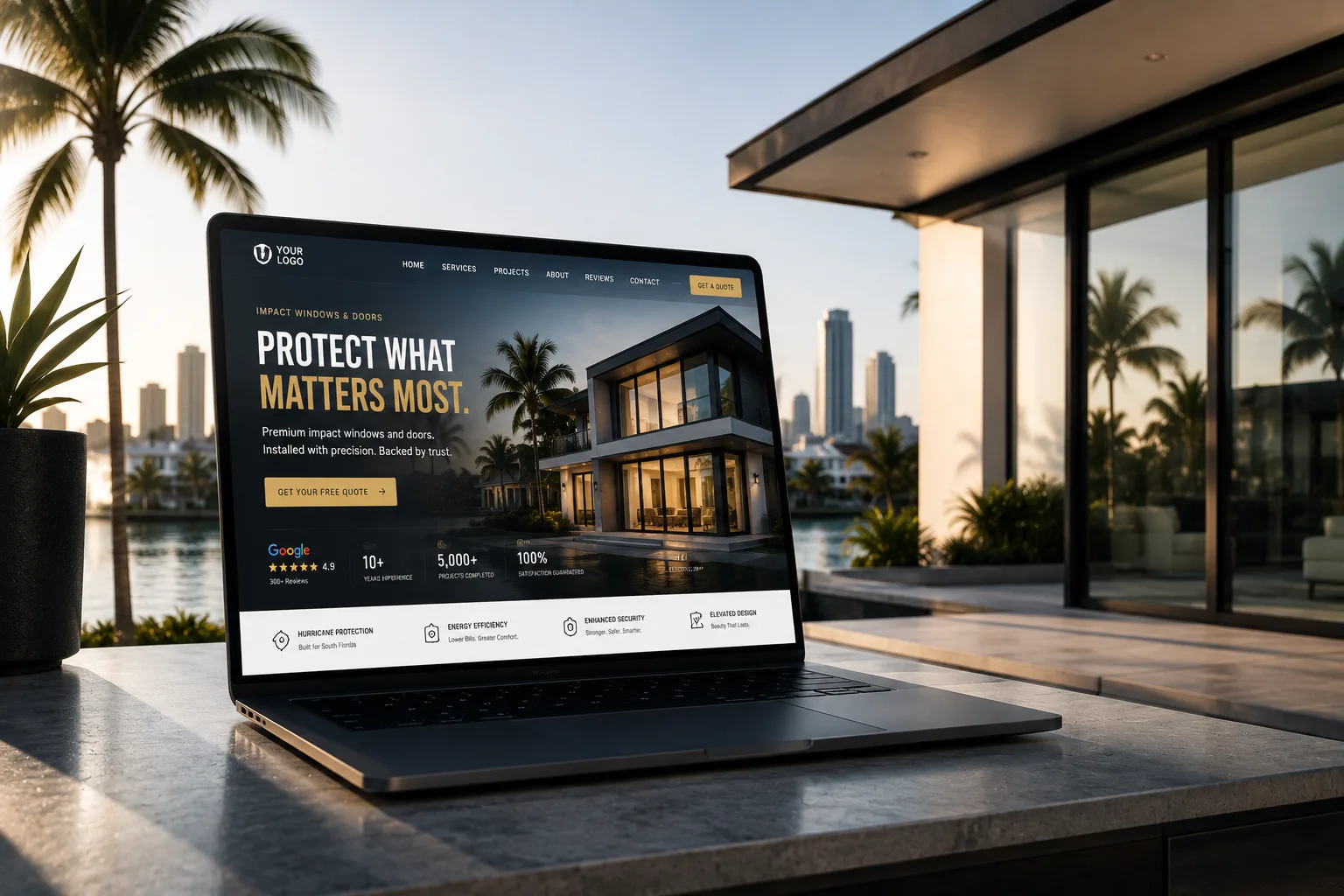
Now that we have analyzed the main points of failure, let's examine the blueprint of a top-performing home service website design. High-converting websites are designed with a single goal: guiding high-intent visitors through a smooth conversion funnel while building trust at every step. This requires coordinating premium design aesthetics with structural engineering.
A successful website design combines several core components:
- Sleek visual hierarchy and modern typography (Oswald titles for impact, Inter body for readability)
- A unified brand color palette featuring a luxury foundation (dark accents, clean zinc backgrounds, premium gold highlights)
- Real human imagery—including high-resolution job site photography and custom team headshots
- Dedicated service landing pages and geo-targeted neighborhood locations targeting local SEO keywords
- Prominent trust credentials, licensing info, active warranties, and financing banners
- High-performance technical SEO: optimized mobile responsiveness, secure hosting, and fast page load times
- Frictionless contact points: dynamic click-to-call buttons, simple estimate forms, and calendar appointment integrations
- Advanced analytics, call tracking, and lead attribution systems linked to your CRM
By building these features into your website design from day one, you establish a solid digital foundation. This ensures that every marketing campaign you launch has a high chance of success, converting expensive clicks into actual inbound phone calls and booked appointments.
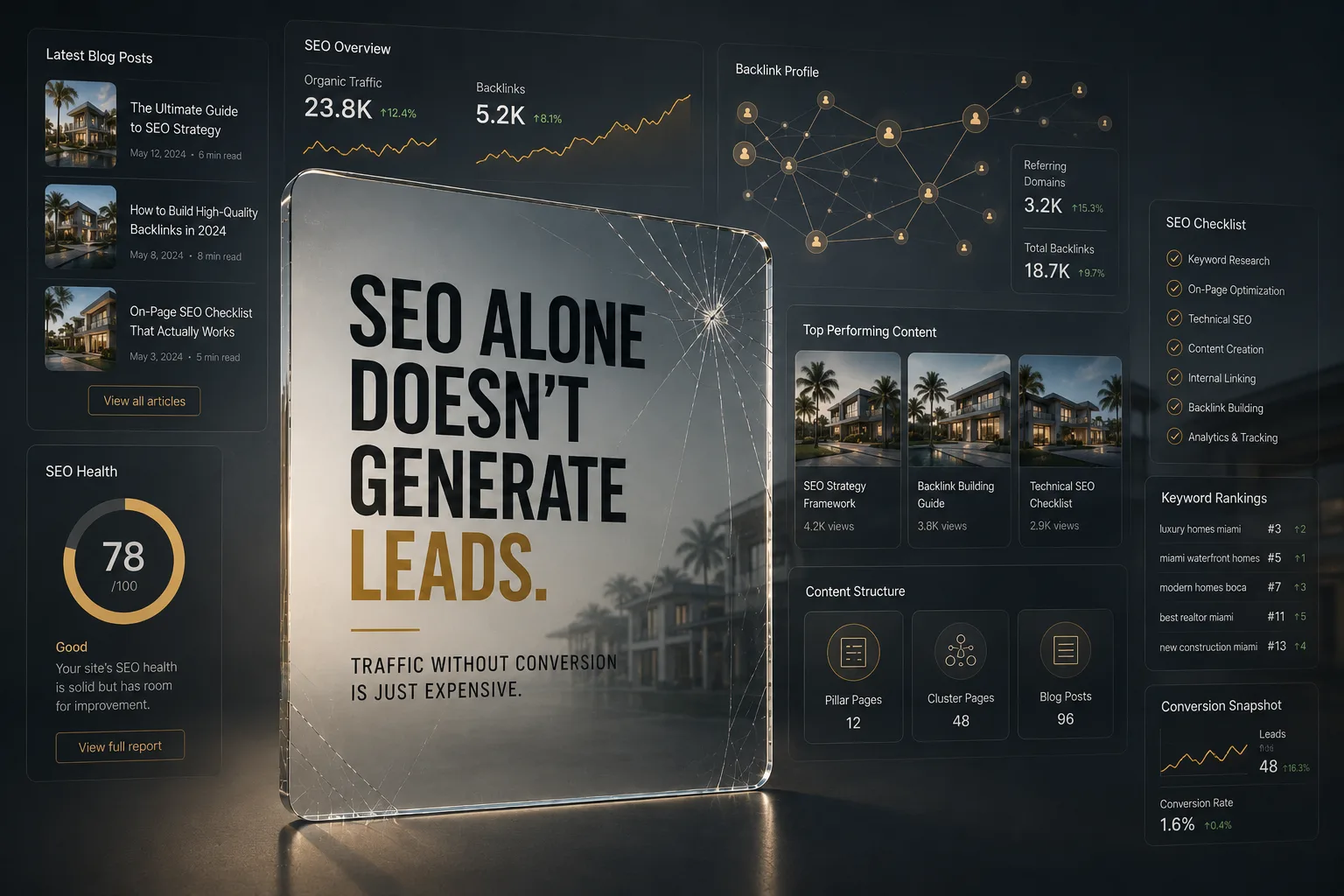
SEO Alone Doesn't Generate Leads
A common mistake contractors make is focusing exclusively on organic rankings. Many business owners believe that if they rank number one for roofing website design or local SEO for contractors, their business will automatically grow. However, rankings are only half of the equation. Search engine optimization gets visitors to your website, but it does not make them call you. Once a homeowner lands on your site, search engines step aside, and user experience (UX) and website conversion optimization take over.
Consider this example: if your website ranks at the top of Google Maps but takes six seconds to load, has no real reviews, and features a confusing contact form, most visitors will click back and choose a different listing. In this scenario, your search ranking is wasted. High search rankings combined with a low conversion rate results in expensive traffic that fails to build your business. SEO and conversion rate optimization must work together. Your search engine strategy should drive high-intent local traffic to a conversion-focused landing page built to turn interest into action.
How Website Strategy Changes By Industry
A single layout does not work for every trade. Homeowner concerns, average project values, and buying timelines differ by vertical. Your website copy and layout must reflect these differences.
Roofing Website Design
Roofing projects are high-ticket, necessary investments. Homeowners are often stressed about leaks, storm damage, or high costs. A successful roofing website design must prioritize trust and financial options. Highlight storm damage response times, GAF or Owens Corning certifications, manufacturer warranties, and financing plans like '$0 down and low monthly payments'. Showcase local project references with before-and-after aerial drone photos to establish authority.
HVAC Website Design
HVAC services are split between emergency repairs and scheduled system replacements. When an air conditioner fails in the middle of summer, a homeowner wants immediate, fast help. They do not want to fill out a long form; they want to call a technician right away. An HVAC website design must feature a prominent, sticky click-to-call phone button, a guarantee of prompt response times, and clear emergency pricing. For scheduled installations, focus on energy efficiency ratings and monthly financing calculations.
Impact Window Website Design
Impact windows and doors are major home upgrades that combine safety, aesthetics, and energy efficiency. Homeowners want to know how windows will protect their families during storms and how they will look from the street. An impact window website design requires high-quality photography showing beautiful home transformations, detailed window specs, wind-rating certifications, and information on insurance premium discounts. Highlight long-term financing plans like Ygrene or PACE that help cover the upfront cost.
Outdoor Living Website Design
Outdoor living projects—such as custom pools, pergolas, screen enclosures, and patio kitchens—are luxury home additions. Homeowners are buying a lifestyle. Copy is less important than visual proof. An outdoor living site needs a visually stunning portfolio with high-resolution drone photography and cinematic video tours. Use a luxury, high-end editorial layout that allows the visuals to tell the story of outdoor living transformations.
What South Florida Contractors Should Prioritize
South Florida is one of the most competitive home service markets in the country. Dense populations, affluent neighborhoods, and intense weather create unique challenges. A contractor website targeting Miami, Fort Lauderdale, Boca Raton, or West Palm Beach must reflect these local dynamics.
If you operate in South Florida, focus on these priorities:
- Highlight storm safety and building codes: reference FBC (Florida Building Code) compliance and High Velocity Hurricane Zone (HVHZ) ratings for impact windows and roofing.
- Build neighborhood-specific pages: write content for specific markets like Coral Gables, Las Olas, Delray Beach, or Palm Beach to build local relevance.
- Showcase local project photography: use images featuring South Florida style homes (Mediterranean, modern coastal, transitional) rather than Northern brick homes.
- Optimize your Google Business Profile: South Florida maps rankings are competitive; populate reviews, post weekly, and link directly to your target city landing pages.
By tailoring your website design and SEO strategy to South Florida, you signal to both search engines and homeowners that you are a local expert who understands local codes and architectural styles.
How Zeus Media Approaches Contractor Websites
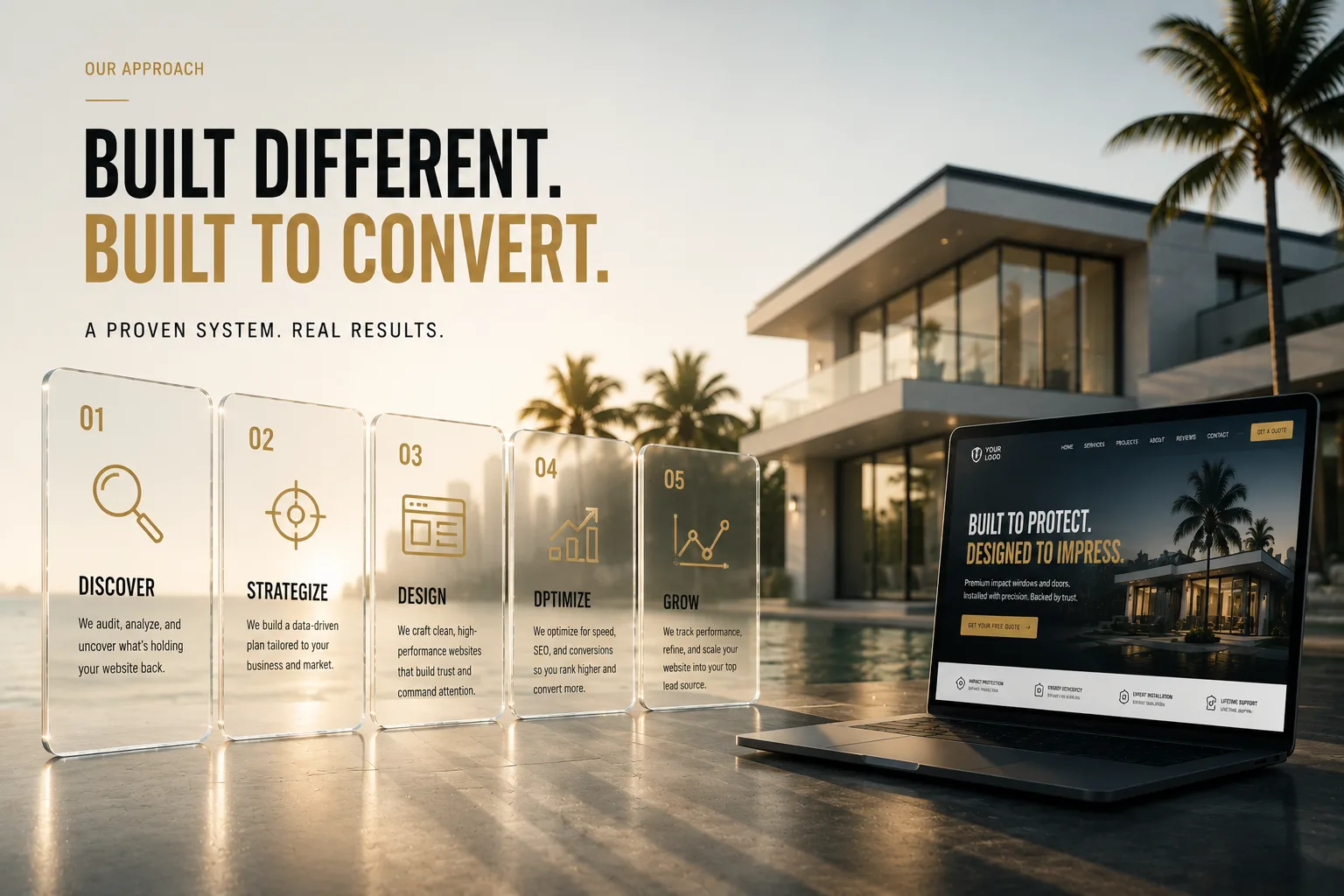
At Zeus Media, we do not build generic websites or copy-paste templates. We engineer custom digital platforms built for home service companies who want to scale. Our process combines research, branding, messaging, search engine optimization, and conversion tracking to deliver measurable results.
Our methodology is structured into key phases:
- Discovery & Strategy: We analyze your local competitors, search patterns, target demographics, and margins to build a custom roadmap.
- Premium Contractor Branding: We refine your brand identity, logos, fonts, and colors to create a modern visual look.
- Copywriting & Messaging: We write conversion-focused, professional copy that speaks directly to your ideal customer's needs and objections.
- Technical Architecture: We build lightning-fast, secure layouts optimized for mobile devices and search crawlers.
- Local SEO & Service Pages: We construct structured service area architectures to maximize Google Maps and organic visibility.
- Conversion Setup: We install dynamic call tracking, clean booking engines, and CRM integrations to measure every lead and job value.
By coordinating these steps, we ensure your website functions as an active sales partner, helping you build authority in your market and consistently book more home service projects.
Most home service companies are losing leads to slow load times, generic designs, and weak calls to action. We can help you identify exactly where your site is losing money. Contact our team today for a complimentary website performance review.
Need Help Improving Your Visibility?
Get a free contractor growth audit and see exactly where your website, SEO, and Google Business Profile can improve.
Book a Strategy CallFrequently Asked Questions
Why doesn't my contractor website generate leads?
What makes a contractor website successful?
How much should a contractor website cost?
How often should contractor websites be redesigned?
Is SEO enough to generate leads?
Why is mobile optimization important?
Do contractor websites need location pages?
How can I improve my website conversion rate?
Joshua Johnson works with premier South Florida roofing, HVAC, window, and outdoor living contractors to build high-converting websites and claim the top positions on search engines.
Related Resources